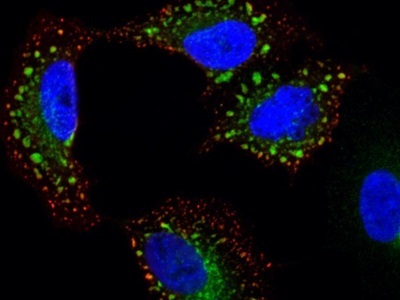
A human lung cell infected with influenza. The viral nucleoprotein is in red, a cellular protein highjacked by influenza is in green, and the cell’s nucleus is in blue. Credit: Emily Bruce, Ph.D. Lab at the Larner College of Medicine
Scientists investigating how influenza viruses replicate within cells “accidentally” discovered that different flu viruses use distinct strategies to infiltrate cells in the first place.
They also found that it is possible to target specific molecules to prevent the viruses from entering new cells, thereby stopping their replication. This discovery provides fundamental insights into how seasonal influenza viruses infect people and points toward a path for developing better medications to prevent infections in the future.
In the study, published in the Journal of Virology, Bruce and team examined H1N1 and H3N2 viruses isolated from the nasal passages of people who tested positive for the flu in 2022. This study initially aimed to learn how viral proteins move within cells and enable viruses to replicate themselves, which is what causes people to become ill.
During this investigation, the team unexpectedly discovered a cellular pathway that blocked the viruses from entering lung cells. The data revealed that H3N2—but not H1N1 viruses—failed to enter human lung cells when a particular protein called Rab11B was depleted. Using reverse genetics, the team mapped this Rab11B-dependent defect and found a novel and H3N2-specific role for Rab11B during viral entry into a lung cell.
This fortuitous discovery suggests that H1N1 and H3N2 viruses enter lung cells via different routes, and it can inform therapeutic targets to prevent viral entry.
“We had previously thought that all flu viruses used the same way to get into a cell, but we discovered that this is not true. H1N1 and H3N2 need different proteins to get in, and if you get rid of the right protein, a specific virus can’t get in,” said principal investigator Emily Bruce, assistant professor of microbiology and molecular genetics at the University of Vermont.
Next, researchers will look to determine whether Rab11B-dependency is a fundamental property of H3N2 that no one realized previously or whether it is new to currently circulating H3N2. They will also seek to better understand how Rab11B functions during H3N2 viral infection at the molecular level.
Data from University of Vermont