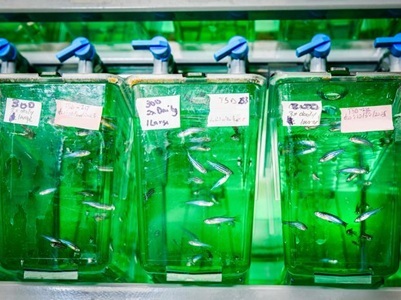
Zebrafish make ideal study subjects as a single pair can produce hundreds of offspring per day and the cost of maintaining them is a fraction of the cost of maintaining laboratory mice. Credit: Craig Pessman via University of Illinois at Urbana-Champaign
Zebrafish are a desirable study animal because one pair can produce hundreds of offspring in a day at a cost that is roughly 70 times lower than the cost of doing the same work in mice. Zebrafish larvae are also transparent, allowing scientists to peer into their insides to see how things develop under different conditions. In research thus far, the findings from microbiome studies in zebrafish parallel those conducted in mice.
A problem arises, however, from the use of “germ-free” animals, which lack the microbes that normally colonize the body. Raising germ-free lab animals is essential to understanding how various species grow, develop and function—with and without their microbiota. Studies of germ-free animals also let scientists see how the animals respond to various chemicals or drugs and test whether host microbes help shape responses to such compounds.
Raising germ-free animals means providing them with germ-free food. This is problematic, as current methods for raising zebrafish involve feeding them live food, which cannot be easily sterilized. This has limited studies of germ-free zebrafish to their larval phase.
Gamma irradiation is used to sterilize chow fed for mammals, but this approach had not been perfected in fish chow.
In a new study, published in mSystems, researchers investigated how increasing doses of gamma-irradiated fish chow affected both normal and germ-free zebrafish. They found that the irradiated chow had no harmful effects on normal or germ-free zebrafish and sustained the fish well into the juvenile stages of development.
Further studies revealed significant differences between the germ-free zebrafish and those with intact microbiomes. Pathways related to metabolizing foreign agents, like agricultural chemicals or pharmaceutical drugs, were downregulated in the germ-free zebrafish, as were genes related to lipid metabolism and immune function. These findings parallel findings in mice and suggest that host microbes play similar roles in immunity and metabolism across species.
“The most interesting part about this work is that now we’ve been able to develop a new husbandry protocol for raising germ-free zebrafish beyond the larval stages that we’ve been limited to for a very long time,” said study author Lydia Okyere, graduate student at University of Illinois Urbana-Champaign. “This is an advance that the field can build upon and use to answer a lot of questions that we’ve been wanting to ask about how the microbiome influences host responses to toxicants like pesticides.”
In future studies, Okyere and team will be exploring whether the microbiome affects how animals metabolize agricultural chemicals, how individual microbes and chemicals may interact to predispose individuals to metabolic disorders, and how host microbiota influence the onset or pathology of behavioral disorders or the development of a healthy immune system.
Data from University of Illinois at Urbana-Champaign